|
Beatbot's new pool robot ecosystem, unveiled at CES 2026, does something no other model can do. I got to see it in action at the mega tech show.
|
|
A startup called ReviMo has developed a robotic system that provides a way for people with limited mobility to lift and transfer themselves — like from a bed to a wheelchair, or to the toilet — without the assistance of a caregiver. ReviMo's Niko has two sets of arms: one that forms a "scooping seat" that slides underneath the person to lift them up, and the other encircling their torso and providing a backrest. It can be operated both by remote and using the controls on its dashboard. Niko in its current iteration can carry up to 250 pounds, but the team says it's working on a version that can support up to 400 pounds.
In addition to aiding in transfers, Niko can lift the rider to a standing level and offers retractable handlebars for support. It also has the potential to be a big help to caregivers, who in many cases assist with multiple transfers every day. Even in a situation where a person isn't able to operate it by themselves, Niko facilitates a transfer that requires much less physical exertion than today's common methods, like sling-based mechanical lift systems. At CES, founder Aleksandr Malaschenko gave a demonstration of its lifting capabilities, using it to scoop him up from a chair and bring him out into the aisle.
Niko is designed to work with most wheelchairs and be compact enough to navigate small bathrooms. It can position a person right above a toilet, and there are disposable seat covers. The goal is to help people with limited ability achieve more independence.
It is the kind of device that, if it delivers on its promises, could be a game-changer for people with limited mobility and paralysis, and their loved ones. My dad was diagnosed with ALS when I was a kid, and I learned how to operate a Hoyer lift by the time I was in middle school. This strikes me as something we would have really appreciated having aroun
|
|
ClOiD, LG's robot butler, was unveiled on the showroom floor. We saw it do some light baking, laundry folding and milk fetching.
|
RELATED ARTICLES | | |
|
Roborock's Saros Rover concept, showcased at CES 2026, climbed stairs using wheel-leg mobility. Roborock also revealed Saros 20 updates and the Qrevo Curv 2 Flow.
The post China's Roborock Unveils a Robot Vacuum That Can Climb Stairs appeared first on eWEEK.
|
|
Boston Dynamics' Atlas is finally entering production. After years of testing this humanoid robot (and forcing it to dance), the robotics company announced at CES 2026 that the final version of the machine is being built now. The first companies to receive deployments will be Hyundai, Boston Dynamics' majority shareholder, and Google DeepMind, the firm's new AI partner.
This final enterprise version of Atlas "can perform a wide array of industrial tasks," according to Boston Dynamics, and is specifically designed with consistency and reliability in mind. Atlas can work autonomously, via a teleoperator or with "a tablet steering interface," and the robot is both strong and durable. Boston Dynamics says Atlas has a reach of up to 7.5 feet, the ability to lift 110 pounds and can operate at temperatures ranging from minus 4 to 104 degrees Fahrenheit. "This is the best robot we have ever built," Boston Dynamics CEO Robert Playter said in the Atlas announcement. "Atlas is going to revolutionize the way industry works, and it marks the first step toward a long-term goal we have dreamed about since we were children."
Boston Dynamics has been publicly demoing its work on humanoid robots since at least 2011, when it first debuted Atlas as a DARPA project. Since then, the robot has gone through multiple prototypes and revisions, most notably swit
|
|
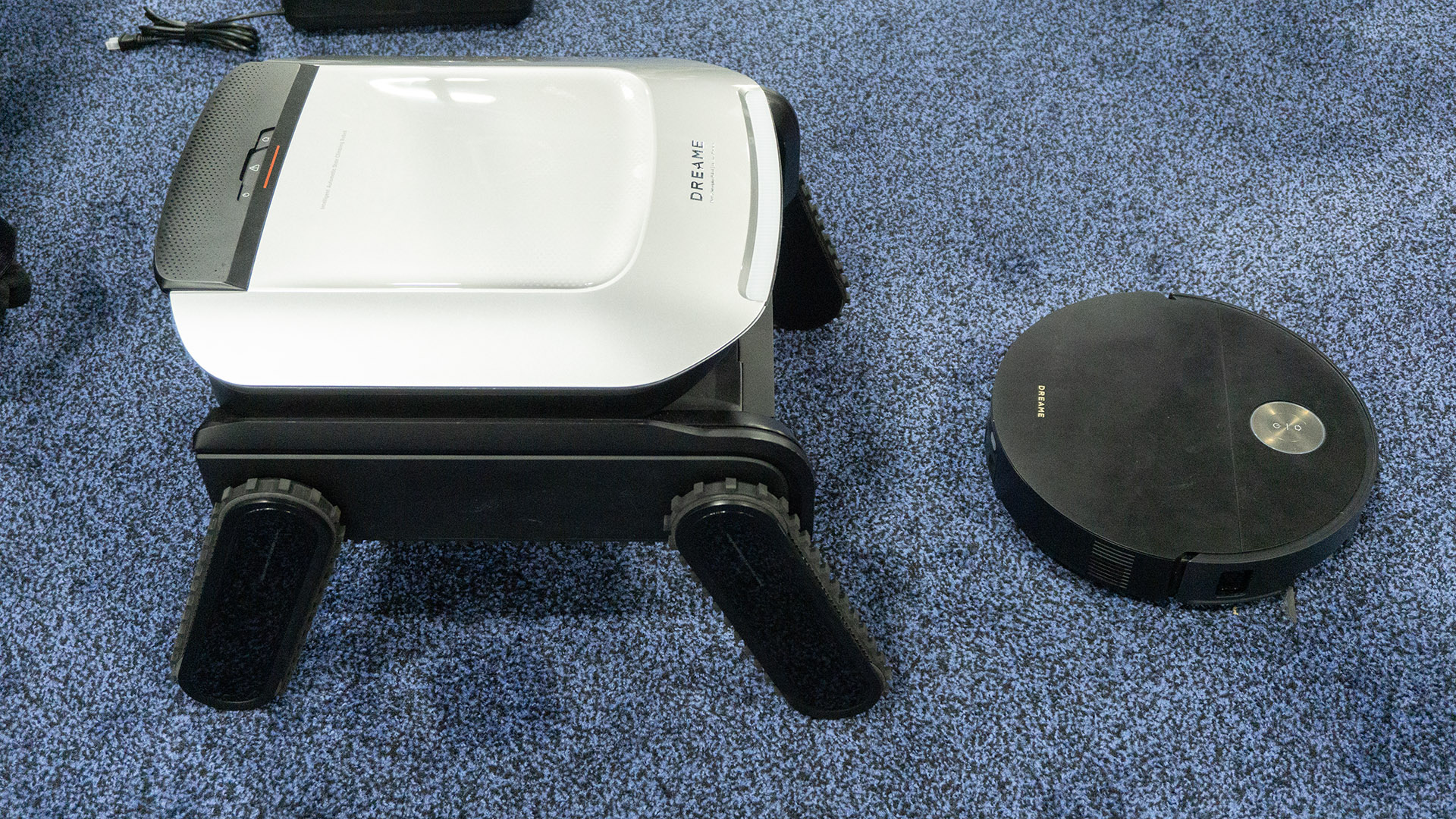 Robot vacuum companies are once again trying to outdo each other at CES 2026. This year, Chinese appliance maker Dreame is showing off a prototype of a device that can climb up and down an entire flight of stairs. Robot vacuum companies are once again trying to outdo each other at CES 2026. This year, Chinese appliance maker Dreame is showing off a prototype of a device that can climb up and down an entire flight of stairs.
The concept, called the Cyber X, was previewed last year at IFA in Berlin. The vacuum sports a somewhat terrifying set of legs with rubber treads that allow it to autonomously navigate multi-story environments. While Dreame has previously shown off vacuums that can move up smaller steps, it says the Cyber X can climb stairs up to 25cm (9.8 inches) high and slopes up to 42 degrees. It can manage both straight and curved staircases, and can climb a flight of steps in 27 seconds, according to the company.
In addition to its legs, the Cyber X also has a built-in water tank to support mopping abilities, and a laser-powered navigation system to help it maneuver up stairs and around other obstacles. It also has a braking system that allows it to stay stable on floors and stairs, even if the battery dies. We haven't been able to see it in action yet, but Dreame is expected to show off its abilities at its CES booth and we'll update this post once we're able to get an up-close look.
Dreame's Cyber X concept and the X60.Karissa Bell for EngadgetFor now, Dreame says Cyber X is just a research prototype and hasn't indicated if it plans to make it, or a robo vac like it, more widely available at some point
|
|
Nvidia's CES 2026 keynote unveiled Alpamayo, a reasoning AI for self-driving cars, plus new supercomputers, speech AI, and robotics models.
The post Jensen Huang: Nvidia Built ‘World's First Thinking, Reasoning Autonomous Vehicle' appeared first on eWEEK.
|
|